Lahinch Golf Club Review: A Complete Guide to Ireland’s Most Iconic Links
Lahinch Golf Club’s Old Course stands as one of the most revered links golf experiences in the world. Set along the dramatic coastline of County Clare on Ireland’s Wild Atlantic Way, this 130-year-old masterpiece combines the golden age of golf course design with modern championship-level conditioning. For any golfer planning a trip to southwest Ireland golf, Lahinch isn’t just a destination, it’s a pilgrimage. This comprehensive guide covers everything you need to know about playing one of Ireland’s greatest golf courses, from its legendary blind holes to the famous goats that predict the weather.
The History of Lahinch Golf Club
1892: The Birth of an Irish Links
Lahinch Golf Club’s story begins in 1892 when Alexander W. Shaw and Richard J. Plummer, officials from Limerick Golf Club, set out along the west coast of County Clare searching for natural sand dunes suitable for golf. What they discovered would become one of Ireland’s greatest sporting treasures. The first game of golf at Lahinch was played on Good Friday, April 15, 1892, between Lieutenant William McFarlane of the Black Watch Regiment and local businessman William F. McDonnell. The course’s natural layout, carved from the spectacular dunes overlooking the Atlantic Ocean, proved immediately exceptional.
Old Tom Morris’s Vision (1894)
Just two years after its founding, Lahinch invited the legendary Old Tom Morris to design a proper course layout. When Morris arrived and surveyed the dramatic landscape, he famously declared it “the finest natural course he had ever seen.” Morris’s 1894 design emphasized the rolling sandhills and created a course that would test golfers’ skills while showcasing the raw beauty of the Irish coast. The routing Morris established became the foundation for all future designs, and several of his holes, most notably the legendary Klondyke and Dell, remain virtually unchanged to this day.
Alister MacKenzie’s Masterpiece (1927)
The most significant transformation came in 1927 when Alister MacKenzie, the visionary architect behind Augusta National and Cypress Point, was invited to redesign the course. MacKenzie received extraordinary freedom to reimagine Lahinch, with only two exceptions: the membership insisted he preserve the Klondyke and Dell holes. With this mandate, MacKenzie relocated most of the course deeper into the towering coastal dunes, creating more dramatic elevation changes and moved greens farther out toward the Atlantic Ocean. He enlarged putting surfaces, increased their slopes, and added confrontational bunker complexes that would challenge golfers from any distance.
MacKenzie’s work at Lahinch is considered among his finest achievements. His strategic bunkering, bold use of natural slopes, and brave green complexes created a course that rewards skill while remaining playable for mid-handicap golfers. The combination of Old Tom Morris’s original vision and MacKenzie’s imaginative enhancement resulted in a truly timeless design.
Martin Hawtree’s Modern Restoration (1999–2003)
By the late 1990s, despite its legendary status, Lahinch needed significant modernization to meet contemporary championship standards. The club commissioned Dr. Martin Hawtree, one of the world’s foremost golf course restoration architects, to carefully update the layout while remaining true to MacKenzie’s original philosophy. Between 1999 and 2003, Hawtree undertook an ambitious renovation that rebuilt 16 tee complexes and completely reshaped 14 greens, restoring them to their original character as conceived by MacKenzie.
Hawtree’s work was transformative. The improvements included re-routing holes toward the Atlantic Ocean, amplifying trouble around greens with bunkers, swales, and mounding that made approach shots from all distances a genuine strategic challenge. The restoration has been widely acclaimed, and Lahinch now consistently ranks among the world’s Top 50 greatest links courses. Recent additional investments include the installation of a cutting-edge irrigation system, expanded practice facilities with a driving range tee box complex, and an indoor performance centre.
Course Overview and Specifications
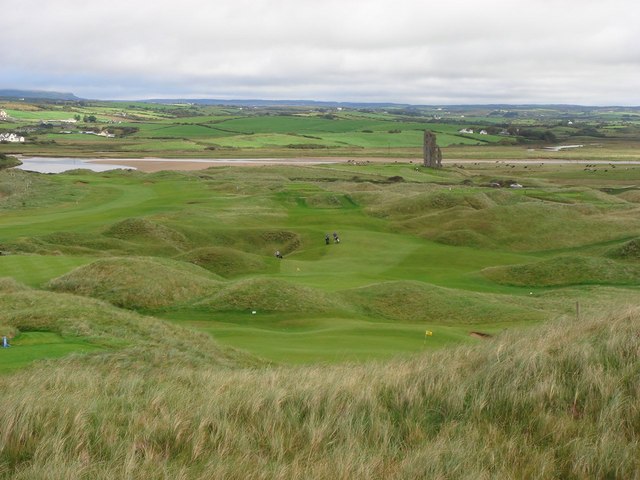
Lahinch’s Old Course is a true links in every sense of the word, a seaside golf course built on natural dune land where rough fescue grasses frame the fairways and the ocean wind is an ever-present test. The course demands respect and rewards precision.
| Course Specification | Details |
|---|---|
| Total Length | 6,950 yards |
| Par | 72 |
| Course Slope | 133 |
| Course Type | Links (seaside dunes) |
| Elevation | Highly undulating with dramatic dune topography |
| Signature Feature | Blind holes and elevated greens |
| Caddies | Required (minimum one per group) |
| Carts | Not available, walking only |
The 133 slope rating reflects the course’s difficulty, particularly in wind. Lahinch plays dramatically longer on windy days, which are frequent on the west coast of Ireland, and can play significantly shorter when conditions are calm. Most golfers should expect to lose distance off the tee due to the exposed coastal location and will find the rough as penal as any links course in the world.
The Famous Goats of Lahinch: Golf’s Original Weather Service
No discussion of Lahinch is complete without mentioning the course’s most beloved residents: the wild goats. This charming legend has become an integral part of the club’s identity and remains one of golf’s most enduring folklore traditions.
The Origins of the Legend
In the early 1900s, a local caddy named Tommy Walsh lived in a small cabin on what was then the third tee of the course. Walsh kept a herd of wild goats, originally intended primarily for milk and companionship. Over time, he and fellow club members began to notice something remarkable: the goats’ behavior seemed to predict the weather with uncanny accuracy. When the goats remained near the clubhouse and surrounding structures, foul weather was typically on the way. Conversely, when the goats dispersed into the dunes and disappeared from view, beautiful playing conditions could be expected.
How the “Weather Service” Works
The goats’ weather-prediction method is straightforward: If the goats stayed near the clubhouse and shelter, rain and poor weather were forecast. If they wandered far out into the open dunes, golfers could expect clear skies and favorable conditions. Whether the goats actually possess meteorological intuition or are simply seeking shelter and grazing remains delightfully unclear, but for over a century, club members and visitors have sworn by the “goat forecast.”
Cultural Legacy
The goats have become such an iconic symbol of Lahinch that the club incorporated a goat into its official logo in 1956. The legend grew to such prominence that in the 1960s, when the club’s barometer malfunctioned, the secretary simply hand-wrote a note on it that read “See Goats.” The phenomenon even captured the attention of Irish national media, a 1971 RTE film documented the goats’ weather-predicting abilities, and numerous journalists and broadcasters have featured the story over the decades.
Today, the wild goats remain on the course as part of the club’s sustainability program, continuing a tradition that dates back more than 120 years. They’ve become beloved residents and a unique attraction for visitors, embodying the authentic, unpretentious character that makes Lahinch special.
Hole-by-Hole Highlights: Playing Lahinch
While all 18 holes at Lahinch deserve respect, several stand out as particularly memorable. Here’s a guide to the course’s most iconic moments.
The 4th Hole: The Klondyke (Par 5, 475 Yards)
The Klondyke is Lahinch’s signature hole and one of the most famous par-5s in links golf. This MacKenzie masterpiece presents a complete test of golf with its tight, sloping fairway and dramatic blind approach shot. The challenge begins immediately: the tee shot must be placed perfectly to utilize the natural slope of the fairway, with players typically favoring the right side to bring the ball back toward the center of the short grass. The second shot is a middle or long iron that must carry over Klondyke Hill, a towering dune that blocks the golfer’s view of the green entirely.
MacKenzie solved the problem of the blind shot by stationing a flagman on the hill who signals when the green is clear. Red means wait; green means play. The flagman’s signals are essential, aim for the invisible “V” in the hill’s contour, and a shot that clears it will likely reach the putting surface and may even offer an eagle opportunity. Under-club here and you’ll find yourself back in the hill, likely facing a bogey or worse.
The Klondyke rewards bold, committed golf while punishing timidity. For many visitors, successfully navigating this hole becomes a highlight of their Lahinch experience.
The Klondyke and the Dell: Lahinch’s Two Most Famous Holes
If you only know two things about Lahinch before you arrive, they will be the 4th and the 5th. Both are blind, both date back to Old Tom Morris in the 1890s, and both survived every later redesign because nobody had the nerve to touch them. Alister MacKenzie reshaped much of the rest of the links in 1927, but he left these two alone, and the modern restoration work did the same. They are not good holes by any textbook definition. They are better than that.
The 4th, the Klondyke, is a short par 5 of roughly 475 yards. You hit a drive down a fairway that looks reasonable enough, and then you walk up to your ball and see the problem: a steep, grass-covered dune sits directly across the fairway, maybe 30 feet high, completely blocking the green. There is a white stone painted near the top to give you a line. You aim at the stone, swing hard, and hope. When you crest the hill and find your ball sitting in the fairway on the other side, it is one of the more satisfying feelings in the game. The locals, by the way, walk it without a second thought, because they have hit that blind shot ten thousand times.
The 5th, the Dell, is the one people argue about. It is a par 3 of about 155 yards, and the green is hidden entirely behind a large dune. You cannot see the putting surface from the tee, only a marker stone on top of the ridge that the greenkeeper moves each morning to show roughly where the flag is that day. The green itself is wide and shockingly shallow, tucked between two big dunes like a letter pushed into a slot. Hit it the right distance and you are putting for two. Come up short or sail it long and you are scrambling out of the marram grass. There is genuinely nothing else like it in championship golf, and people who hate it tend to hate it because they made a six. Play it twice and you start to love it.
Green Fees, Booking and Visitor Access
Let me be straight about the cost, because Lahinch is not cheap any more. For the main 2026 season, which runs roughly from late April to mid October, the visitor green fee on the Old Course sits at around 450 euros per round. That was a 20 percent jump on the previous year, and the club has made no secret of it. Shoulder months and the quieter early and late parts of the calendar are usually a fair bit lower, so if the headline number stings, it is worth asking about dates either side of peak. Prices move every season, so confirm the current figure with the club directly before you commit.
Booking is done through the club’s online tee time system or by contacting the office. Popular summer mornings go early, and if you are travelling a long way for this, book months ahead rather than weeks. There is no formal handicap certificate demanded at the desk in my experience, but Lahinch expects you to be a competent golfer who can keep pace, and the course will expose anyone who is not. Bring a real game and a sense of pace-of-play and you will be fine.
One thing that catches visitors out: caddies are effectively mandatory on the Old Course. The club asks that every group take at least one caddie, and unless you say otherwise they will reserve them for you automatically. Honestly, take one each if you can afford it. A caddie fee runs somewhere around 50 to 60 euros per bag plus a tip, and on a blind, quirky links you have never seen, the lines and reads they give you are worth every cent. This is a walking course with no ride-on buggies, though pull trolleys and a limited number of electric trolleys can be hired.
Best Time to Play Lahinch
The realistic window for Lahinch is May through September, with the fringes of April and October playable in decent years. This is the west coast of Ireland on the edge of the Atlantic, so the weather does what it likes regardless of the month, and that is part of the deal with links golf. You will probably get wind. You might get all four seasons in one round. Pack waterproofs even in July and you will never regret it.
For pure conditions, June and July are the pick. Daylight is enormous at midsummer, with light stretching well past 10pm, so you can play late and never feel rushed, and the greens are typically at their best from late spring through early autumn. The trade-off is that these are the busiest and priciest weeks, and the course shares its slice of Clare with every tourist heading to the Cliffs of Moher.
If value and elbow room matter to you, look at May and September. You still get long evenings and reasonable weather, the crowds thin out, and the green fee in the shoulder periods tends to be gentler than peak. My own preference is a September trip: the turf is firm and running after a summer of play, the light is lovely and low in the evenings, and you are not fighting for a tee time. Just keep an eye on the forecast, because by late September the first autumn storms can roll through.
Beyond the Round: The Cliffs of Moher and the Clare Coast
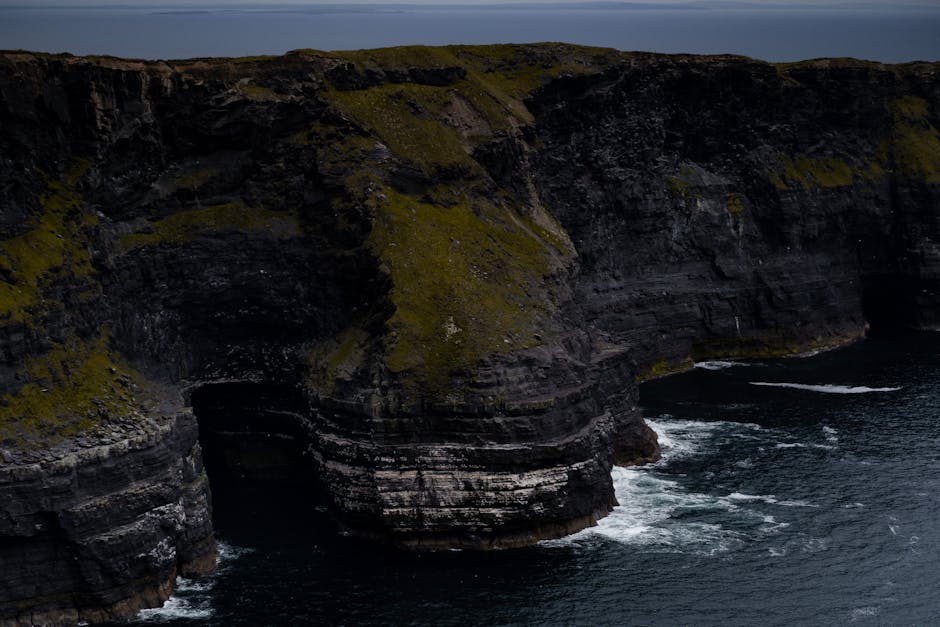
The good news for anyone planning a trip is that Lahinch sits in one of the most rewarding corners of Ireland, so the non-golf time is easy to fill. The Cliffs of Moher are only about eight kilometres up the road, and they live up to the hype: 200 metres of sheer rock dropping into the Atlantic, with O’Brien’s Tower at the high point. Go early or late in the day to dodge the coach parties, and if the wind is up you will feel it. It is one of the most popular natural sights in the country for a reason.
For more golf, Doonbeg (the Greg Norman links on Doughmore Bay) is roughly 40 minutes south and makes an obvious second round for a Clare golf trip. Inland you have the Burren, a strange and beautiful expanse of bare limestone with sites like the Poulnabrone dolmen, and you can catch a ferry from Doolin out to the Aran Islands or along the base of the cliffs by boat.
Doolin, about 20 minutes north, is the heart of the area’s traditional music scene, and Gus O’Connor’s there is a proper session pub. Closer to the course, Lahinch village has plenty of bars and food within walking distance of the dunes. For dinner worth driving to, Vaughan’s Anchor in Liscannor does excellent seafood, and the Wild Honey Inn near Lisdoonvarna has a serious reputation. After a round in the wind, a bowl of Clare chowder and a pint of stout by a turf fire is exactly the right way to finish.
The Verdict: Is Lahinch Worth Playing?
Yes, without much hesitation, but go in with the right expectations. Lahinch is not a polished, modern, every-hole-in-front-of-you championship course, and if that is what you want there are cleaner options. What it is instead is roughly 6,950 yards and a par of 72 of genuinely characterful links golf, with blind shots, wild greens, dunes you hit over rather than around, and the famous goats that wander the dunes and supposedly forecast the weather. It is the kind of place that gets called the St Andrews of Ireland, and the comparison is fair in spirit if not in scale.
The honest cons are the price, which is now steep, and the quirk, which is not for everyone. The Klondyke and the Dell will frustrate a certain type of golfer who wants every shot laid out in front of them. But that quirk is the entire point. Old Tom Morris and Alister MacKenzie left their fingerprints all over this links, the club is good enough to be hosting the Walker Cup in 2026, and it still feels like a real golf course rather than a manufactured resort experience.
If you are building a south-west Ireland golf trip and you can stomach the green fee, put Lahinch on the list and do not treat it as a one-off. Play it twice if you possibly can. The first round you spend baffled and reaching for the camera; the second round, once you know where the blind shots are going, is when you actually fall for the place. That is the mark of a course worth the money and the journey.
Related guides
- Read our full guide to Ireland golf course reviews
- See also: Waterville golf course review
- See also: Old Head golf links review
- Ballybunion Old Course Review
- Royal Portrush Dunluce Course Review
- Royal County Down Review
- Tralee Golf Club Review
- Portmarnock Golf Club Review
- Adare Manor Golf Course Review
- Ballyliffin Glashedy Links Review
- County Sligo (Rosses Point) Review
- Carne Golf Links Review